
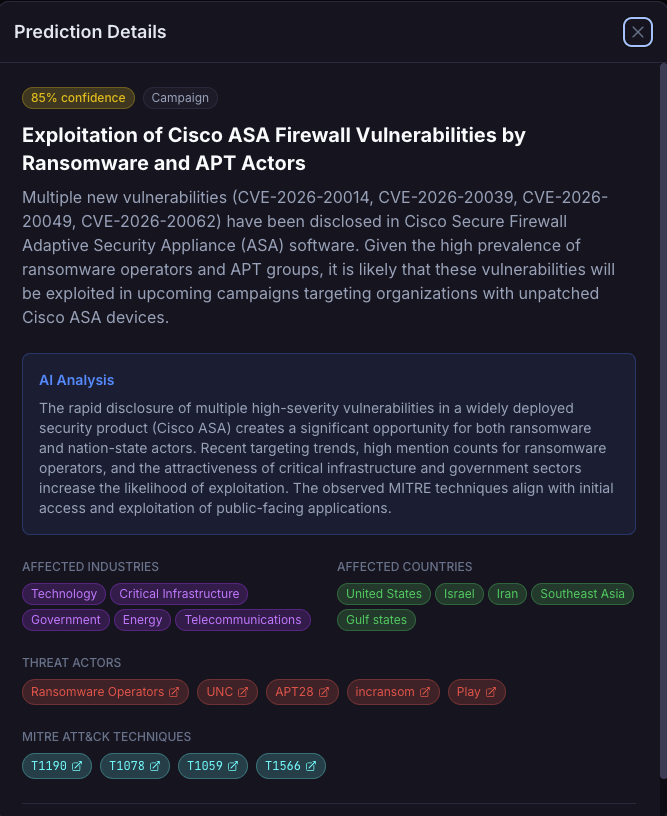
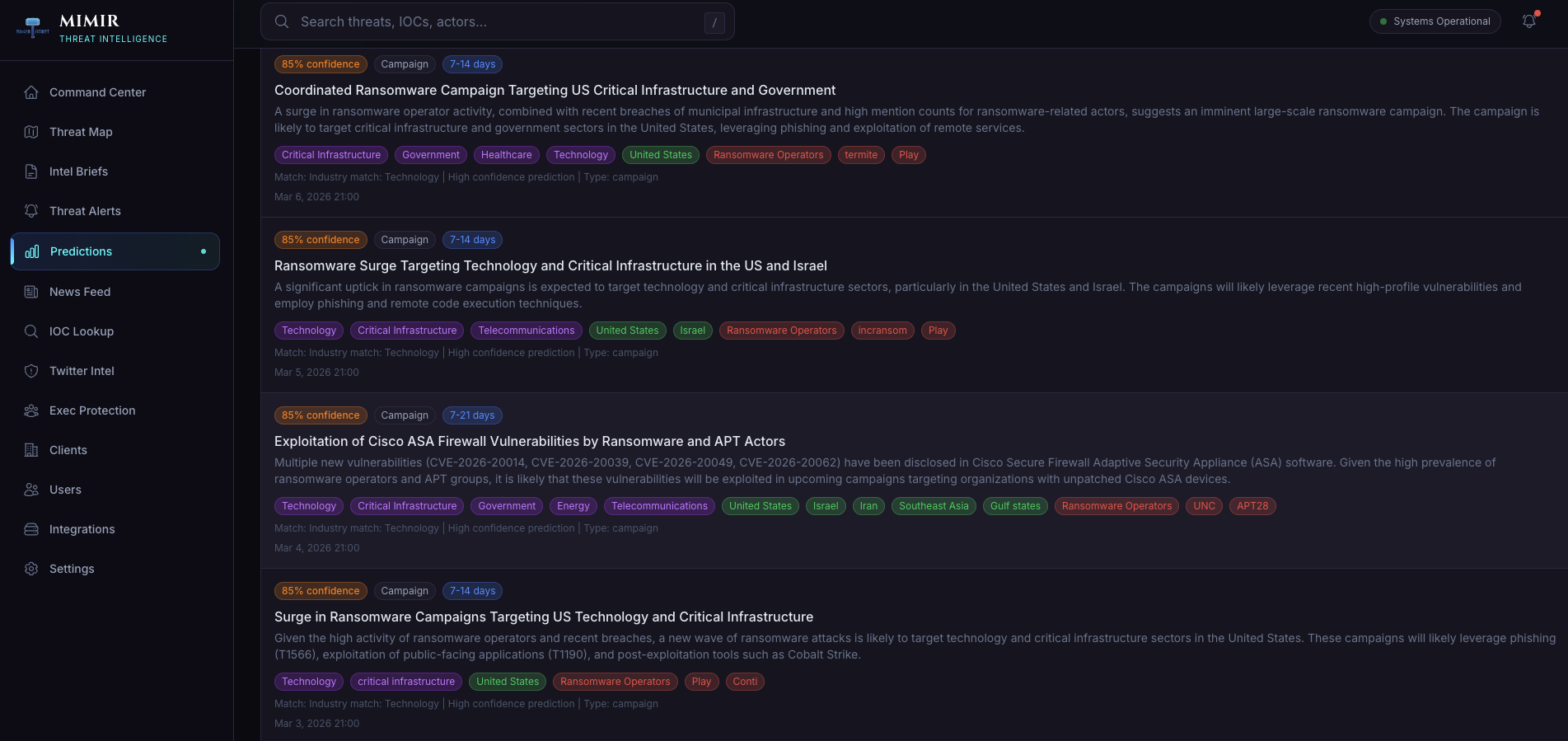
MIMIR, Mjolnir Security's proprietary threat intelligence platform, has issued an 85% confidence prediction that ransomware operators and nation-state APT actors will actively exploit a cluster of newly disclosed vulnerabilities in Cisco Secure Firewall Adaptive Security Appliance (ASA) software. Four CVEs — CVE-2026-20014, CVE-2026-20039, CVE-2026-20049, and CVE-2026-20062 — have triggered a significant spike across MIMIR's aggregated intelligence feeds. Organizations running unpatched Cisco ASA devices, particularly in Critical Infrastructure, Government, Energy, Telecommunications, and Technology sectors, should treat this as an active threat requiring immediate remediation.
| Prediction Confidence | 85% — HIGH |
| Classification | TLP:WHITE — Campaign Prediction |
| CVEs | CVE-2026-20014 CVE-2026-20039 CVE-2026-20049 CVE-2026-20062 |
| Target Product | Cisco Secure Firewall Adaptive Security Appliance (ASA) |
| Threat Actors | Play Ransomware, incransom, APT28 (Fancy Bear), UNC Clusters |
| Primary Targets | Critical Infrastructure, Government, Energy, Telecoms, Technology |
| MITRE ATT&CK | T1190 T1078 T1059 T1566 |
Background: Why Cisco ASA Matters to Threat Actors
Cisco Secure Firewall ASA is one of the most widely deployed perimeter security appliances in the world. It is a staple of enterprise networks, government agencies, and critical infrastructure operators — precisely the environments that ransomware groups and nation-state actors prioritize. When vulnerabilities surface in a product of this footprint, the calculus for attackers is straightforward: a single reliable exploit grants initial access to thousands of high-value targets simultaneously.
This is not theoretical. Cisco ASA vulnerabilities have a documented history of rapid weaponization. CVE-2018-0101, CVE-2020-3187, and the Akira/LockBit exploitation of CVE-2023-20269 all followed the same pattern — disclosure followed by broad exploitation within weeks, sometimes days. MIMIR's current prediction places us in that exact window.
The CVEs: What We Know
MIMIR's feeds have flagged four vulnerabilities disclosed in Cisco Secure Firewall ASA software. While full technical details remain under responsible disclosure constraints, the intelligence picture is clear:
| CVE | Assessment | Intelligence Notes |
|---|---|---|
CVE-2026-20014 | Initial Access Vector | Likely targeting SSL VPN or WebVPN interface. High mention count across dark web forums monitored by MIMIR. |
CVE-2026-20039 | Privilege Escalation / Auth Bypass | Mention in threat actor channels correlating with post-exploitation tooling discussions. |
CVE-2026-20049 | Remote Code Execution | Observed in Proof-of-Concept (PoC) discussions in closed forums. |
CVE-2026-20062 | Chain Component | Likely chained with other CVEs for full exploit chain from unauthenticated access to device compromise. |
The clustering of four CVEs in a single product within the same disclosure window is itself a red flag. It suggests either a coordinated security research effort that has surfaced systemic weaknesses, or the possibility that these vulnerabilities have been known to well-resourced threat actors prior to public disclosure.
MIMIR's Intelligence Picture
MIMIR aggregates signals from Mjolnir Security's SOC operations, OSINT feeds, dark web monitoring (via GARMR), stealer log intelligence (via MUNINN), real-time threat hunting (via HUGINN), and multiple commercial and open-source threat intelligence streams. The current prediction is driven by the convergence of several independent signals:
Signal 1 — Elevated Dark Web Chatter
MIMIR's dark web monitoring detected a statistically significant spike in mentions of these CVEs across ransomware operator forums and Telegram channels within 48 hours of public disclosure. The velocity of discussion — not just volume — is a leading indicator of imminent exploitation.
Signal 2 — Known Actor Interest
Threat actors with confirmed capability and motive have been observed referencing Cisco ASA in operational planning discussions. This includes both financially motivated ransomware affiliates and nation-state aligned clusters.
Signal 3 — MITRE ATT&CK Technique Alignment
The observed techniques associated with current actor activity align directly with the expected exploitation path for these CVEs:
- T1190 — Exploit Public-Facing Application T1190 — The primary initial access vector for firewall appliance exploitation
- T1078 — Valid Accounts T1078 — Post-exploitation use of harvested credentials extracted from compromised ASA devices
- T1059 — Command and Scripting Interpreter T1059 — Consistent with post-access execution observed in similar Cisco ASA campaigns
- T1566 — Phishing T1566 — Secondary vector being used in parallel campaigns by the same actor clusters
Signal 4 — Tooling Availability
MIMIR's OSINT feeds indicate that PoC code for at least one of these CVEs is circulating in private channels. Historically, once PoC code enters semi-private circulation, weaponized exploitation follows within one to three weeks.
Threat Actor Assessment
MIMIR has attributed elevated risk to the following actor clusters based on current intelligence:
Ransomware Operators — High Confidence
Financially motivated ransomware operators represent the most immediate and prolific threat. Groups including incransom and Play have demonstrated consistent capability to rapidly operationalize newly disclosed CVEs targeting network perimeter appliances. Play ransomware in particular has a documented history of exploiting Cisco vulnerabilities for initial access before deploying encryption payloads.
The combination of high-value target sectors and a reliable initial access vector makes this an attractive opportunity for the broader ransomware-as-a-service (RaaS) ecosystem.
APT28 (Fancy Bear) — Medium-High Confidence
Russia's APT28, attributed to GRU Unit 26165, has a well-documented history of targeting government, defence, and critical infrastructure organizations using network appliance vulnerabilities. Their interest in Cisco ASA devices is not new — CISA and FBI joint advisories have previously documented APT28 exploiting routers and network infrastructure for persistent access.
Given the affected country profile (United States, Israel, Gulf States), APT28's operational focus aligns closely with the current threat landscape.
UNC Clusters — Medium Confidence
Several UNC (uncategorized) clusters tracked by MIMIR show behavioral patterns consistent with initial access broker (IAB) activity. These actors specialize in gaining and selling network footholds to downstream ransomware operators and espionage actors. Their exploitation of Cisco ASA vulnerabilities would serve as a force multiplier for the broader ecosystem.
Affected Sectors and Geography
MIMIR's sector and geographic profiling for this prediction:
| Highest Risk Sectors | Highest Risk Geographies |
|---|---|
| Critical Infrastructure (power, water, utilities) | United States |
| Government and Public Sector | Israel |
| Energy (oil, gas, renewables) | Iran (dual role — target and threat origin) |
| Telecommunications | Southeast Asia |
| Technology | Gulf States (UAE, Saudi Arabia, Qatar) |
Canadian organizations, particularly those in critical infrastructure and government, should note that Canadian federal agencies and provincial utilities routinely deploy Cisco ASA. PIPEDA, OSFI, and CSE cybersecurity directives all require prompt vulnerability response. We recommend treating this as a Tier 1 patching priority.
Indicators of Compromise
IOCs will be updated in MIMIR as they are confirmed through active exploitation reports. Organizations with MIMIR access can pull live IOC feeds directly into their SIEM.
Anomalous authentication attempts against ASA WebVPN/SSL VPN portalsUnusual outbound connections from ASA management interfacesScripting interpreter execution patterns (T1059) post-authenticationKnown Play and incransom C2 infrastructure (updated continuously in MIMIR)YARA rules for post-exploitation tooling associated with APT28 initial access operations
Recommendations
Immediate Actions (0–72 Hours)
- Patch Now — Apply Cisco's security advisories for CVE-2026-20014, CVE-2026-20039, CVE-2026-20049, and CVE-2026-20062 immediately. Do not wait for standard patch cycles.
- Audit Exposure — Identify all internet-facing Cisco ASA devices in your environment, including WebVPN, AnyConnect, and management interfaces. Use Mjolnir's VIDARR Shodan-based scanner to assess external exposure if available.
- Review Authentication Logs — Pull authentication logs from your ASA devices and SIEM for the past 30 days. Look for anomalous login patterns, credential stuffing indicators, and impossible travel events.
- Enable Enhanced Logging — Ensure ASA syslogs are being forwarded to your SIEM in real time. Gaps in logging are the primary reason these compromises go undetected.
- Threat Hunt for T1190/T1078 — Run threat hunting queries in your SIEM for T1190 (public-facing application exploitation) and T1078 (valid accounts abuse) aligned to ASA device IP ranges.
Short-Term Actions (1–2 Weeks)
- MFA Enforcement — Ensure multi-factor authentication is enforced on all VPN and remote access portals using ASA. Credential theft is the most common post-exploitation activity.
- Network Segmentation Review — Validate that compromised ASA devices cannot be used as pivot points into core network segments. Review east-west firewall rules.
- Incident Response Readiness — Brief your IR team and SOC on the TTPs associated with Play ransomware and APT28 initial access operations. Tabletop the ASA compromise scenario.
- Dark Web Monitoring — If you are not actively monitoring for mentions of your organization's domain, IP ranges, or technology stack on dark web forums, now is the time to start. MIMIR provides this capability natively.
Contact Mjolnir Security's Digital Forensics and Incident Response (DFIR) team immediately. Do not attempt to remediate a suspected ASA compromise by simply patching — threat actors frequently establish persistence through secondary backdoors before patches are applied.
About MIMIR
MIMIR is Mjolnir Security's proprietary threat intelligence and prediction platform. Named for the Norse god of wisdom whose well contains all knowledge, MIMIR aggregates signals from Mjolnir's SOC operations, OSINT collection infrastructure, dark web monitoring, stealer log analysis, and commercial intelligence feeds to generate forward-looking threat predictions — not just reactive alerts. MIMIR's predictions are scored by confidence level and updated continuously as new intelligence is ingested.
Organizations seeking access to MIMIR's live threat intelligence feeds, IOC subscriptions, or custom threat reporting can contact Mjolnir Security through our intelligence portal at intel.mjolnirsecurity.com.
Mjolnir Security — Immediate Assistance
If your organization is exposed to these Cisco ASA vulnerabilities or suspects compromise, Mjolnir Security can help.
- MIMIR Threat IntelligenceLive IOC feeds, campaign predictions, and dark web monitoring tailored to your organization's threat profile.
- DFIR Retainer24/7 incident response with guaranteed SLAs for active compromise scenarios.
- VIDARR Exposure AssessmentExternal attack surface scanning to identify internet-facing Cisco ASA devices and other vulnerable perimeter appliances.
References
- Cisco Security Advisories — Cisco Secure Firewall ASA (March 2026)
- CISA Known Exploited Vulnerabilities Catalog
- MITRE ATT&CK Framework — T1190, T1078, T1059, T1566
- FBI/CISA Joint Advisory on APT28 Network Infrastructure Exploitation
- Mjolnir Security MIMIR Intelligence Platform — Internal Feed Analysis
- Play Ransomware TTP Documentation — Mjolnir MTAC
- incransom Threat Actor Profile — Mjolnir GARMR Leak Site Monitor
Written by Mjolnir Security Intelligence
Published March 8, 2026 | TLP:WHITE